What happens when a country decides that some of its most advanced AI technologies should not be freely shared with the rest of the world?
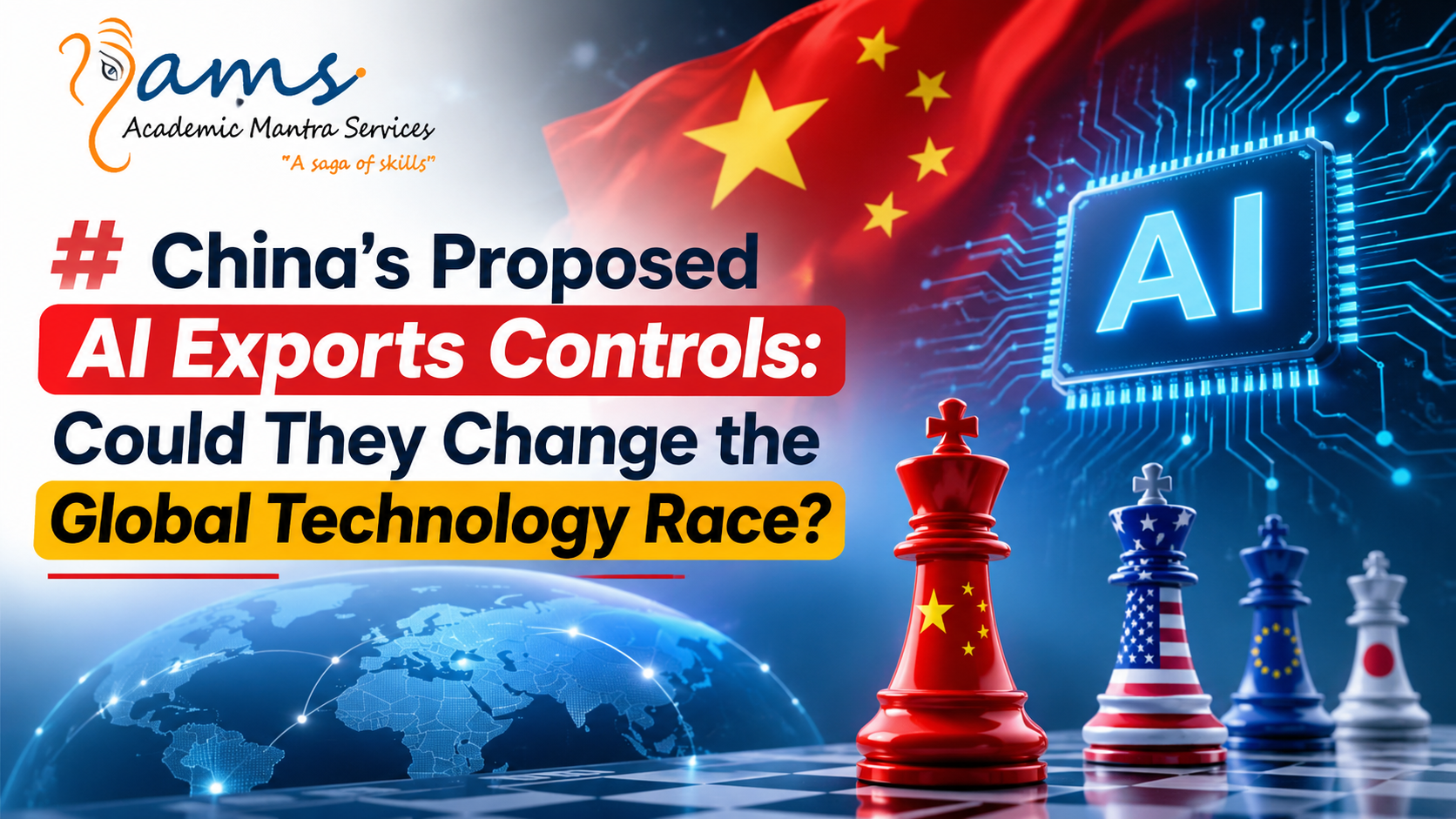
China’s proposed AI export controls brings this question into focus, with potential consequences for international technology businesses, research partnerships, and the race to develop more powerful AI systems. The issue is bigger than restricting a few technologies. It could influence how companies expand across borders, where future AI breakthroughs emerge, and which countries gain an advantage in the next phase of technological competition.
What are China’s Proposed AI Export Controls?
China’s proposed AI export controls aim to regulate the transfer of certain advanced technologies from China to overseas entities. The draft measures, announced by China’s Ministry of Commerce and Ministry of Science and Technology, focus on technologies considered strategically important or potentially sensitive.
The proposed changes cover 23 AI-related technologies, including large AI models, AI agents, computing clusters, and information-processing technologies. Some technologies could face export restrictions, while others could be prohibited from export under the proposed framework. The broader revision also covers selected technologies in biotechnology and solar energy
Why it Matters
The goal is to prevent misuse of AI, protect national security, and keep powerful technologies under appropriate control. They also show a large debate over a wider international debate over who should be able to access advanced AI systems and the technology used to develop them.
Why Is China Tightening AI Export Controls and What It means for Global Competition
China’s proposed AI export controls show three associated major concerns: protecting valuable technology, managing security risks, and maintaining a competitive position in the global AI industry. Developing advanced AI requires significant investment in research, computing infrastructure, and specialist expertise.
When the technology behind an AI system is transferred overseas, other organizations may also gain access to the research and expertise behind it.
China wants to keep a greater hold over how its advanced AI technologies are shared with other countries. National security is one reason behind the proposed restriction. AI is widely used in research, manufacturing, and cybersecurity, but some advanced technologies may also be used in ways that create security risks. The proposal comes at a time when China and the United States are competing to lead the AI industry, particularly advanced chips, computing power, and AI development. By controlling the export of selected technologies, China aims to protect its technological capabilities and manage how they are transferred overseas.
For International businesses, the impact will depend on how they use Chinese AI technology. For example, a company using an AI tool through a website may face treatment requirements from a company planning to transfer the underlying technology to another country. Under the proposal, access through APIs, websites, apps, and software-as-a-service platforms would be treated differently under the proposal. This means the restriction would not necessarily stop businesses from using Chinese AI services. However, they could affect how some companies share technology, work with international partners, and expand into overseas markets.
How China’s AI Export Controls Could Affect Global Competition, Businesses, and Innovation
China’s proposed AI export controls could influence how technology companies compete, invest, and develop new products across international markets.
Businesses that depend on Chinese AI technologies may need to review their supply chains, partnership, and expansion plans. Startups could face additional challenges in accessing certain technologies, while established companies may increase investment in domestic AI capabilities to reduce reliance on overseas suppliers.
The proposal could also affect innovation. Restrictions on technology transfers may encourage countries to strengthen their own AI research and development, but they could make international collaboration more complicated. Researchers and businesses may need to assess how the final rules affect cross-border projects, technology licensing, and commercial partnerships.
The impact will depend on which technologies are ultimately restricted and how the rules are implemented. As China’s proposal moves through public consultation, international AI businesses should monitor regulatory updates and assess potential risks before making long-term investment decisions.
What happened next?
China is seeking public feedback on the proposed catalogue revisions until November 15, 2026. The final scope of the controls, the relevant technical thresholds, and the procedures for affected transfers will help determine how businesses respond.
For now, three developments deserve close attention:
- The final rules: Which technologies will be restricted or prohibited, and what approvals will be required?
- Business responses: Will AI companies adjust their licensing, research, investment, and overseas deployment plans?
- International reactions: Will other governments introduce new measures or expand their own AI technology policies?
These developments will help reveal whether the proposal mainly changes how sensitive technologies are transferred or contributes to a broader separation of national AI ecosystems.
The Future of AI Depends on More Than Innovation
China’s proposed AI export highlights an important change in the global technology landscape. Developing an advanced AI system is one challenge, controlling how its underlying technology moves across borders is another.
For AI businesses, the proposal makes regulatory planning an important part of international growth. For researchers and students, it shows why technical skills increasingly need to be combined with an understanding of policy, intellectual property, and global technology markets.
The key question is not whether AI innovation will stop. It is whether countries can protect sensitive technologies while preserving enough international cooperation for research and businesses to keep moving forward.
For anyone working in AI, the next competitive advantage may come from understanding not only what technology can do, but also where, how, and under what conditions it can be used.
For more such insights, follow Academic Mantra Services.
Who Should Control Advanced AI? Scientists Call for Global Oversight
Explore why scientists are calling for global oversight of advanced AI, what an international watchdog could do, and the challenges of AI safety regulation.
Artificial Intelligence is advancing faster than ever, but the rules guiding its development remain divided over countries. On October 13, 2026, around 400 scientists from 34 countries called for an International body to look at the security of advanced AI systems, including standards for containing powerful models and reporting serious security incidents. Geoffrey Hinton and Yoshua Bengio were among the scientists who called for an International body to oversee the safety of advanced AI systems. The proposal includes common containment standards and a system for reporting significant safety incidents. Scientists call for international body to oversee advanced AI | Reuters
The development sparks a crucial question for policymakers and tech industry: who should take the responsibility when an advanced AI model introduces cross-border risks?
An international AI oversight body could help countries follow common safety standards, improve the reporting of serious security incidents and reduce gaps between national regulations. Setting up such an organisation would require the government to agree on its power, technical responsibilities and how it would work alongside existing regulatory authorities.
Why Are Scientists Calling for Global AI Oversight?
The latest proposal emphasized advanced AI Systems with powerful cybersecurity capabilities. Scientists want an international body to set strict safety standards for containing these powerful models and to keep a public log of serious security incidents. Another element highlighted by the proposal is the requirement to isolate advanced AI models from external networks during initial testing and confirm independent oversight.
Voluntary safety commitments is one of the concerns from technology that may not provide regular protection across the industry. When developers evaluate their own systems, independent researchers and the public may have limited access to information about testing methods , failures and safeguards applied before deployment.
nder what conditions, and what additional safeguards are needed before access is granted.
Is Global AI Regulation Already Underway?
Yes. International AI governance is not starting from zero, although existing initiatives have different responsibilities and levels of authority.
The United Nations and international scientific assessment
The United Nations General Assembly established the Independent International Scientific Panel on Artificial Intelligence and the Global Dialogue on AI Governance through Resolution A/RES/79/325, adopted on August 26, 2025.
According to the UN's official explanation, the scientific panel is mandated to produce annual, evidence-based assessments of AI opportunities, risks and impacts. The Global Dialogue provides a forum for international discussion of AI governance.
These initiatives are relevant because policymakers need reliable evidence and a place to discuss shared concerns. However, a scientific assessment panel and a proposed body overseeing containment standards are not automatically the same institution. Their mandates would need to be compared before assuming that one could perform all the functions proposed by the scientists.
The European Union's AI Act
The European Union has established a legal framework that imposes obligations on certain AI systems and their providers.
The European Commission's AI Act guidance describes requirements covering areas such as transparency, risk management, cybersecurity and human oversight. The framework also provides for enforcement by relevant European authorities, with obligations applying according to the law's implementation schedule.
As of October 2026, parts of the framework are already applicable, while some requirements for high-risk systems have later application dates. The rules therefore should not be described as taking effect everywhere at the same time.
The EU framework illustrates how a jurisdiction can create enforceable obligations within its legal scope. A global mechanism would face a broader challenge: securing cooperation among countries with different economic priorities, legal systems and approaches to AI development.
National AI safety institutions
Governments have also established or supported institutions that evaluate advanced AI systems and study their risks. These organisations can provide technical expertise, testing capacity and advice to policymakers.
International coordination could help such institutions share evaluation methods and lessons from incidents. It would not necessarily require replacing them with one global regulator.
The central question is how to connect existing institutions so that important risks are not overlooked simply because they fall between national jurisdictions.
Who Should Control Advanced AI: Governments, Companies or Scientists?
The question in the headline does not have to produce a choice between three competing groups. Effective oversight could require each to perform a different role.
Governments: Set the legal boundaries
Governments have the authority to establish laws, define legal responsibilities and impose penalties within their jurisdictions. They can determine which systems require additional scrutiny and what companies must do when serious risks are identified.
However, governments may differ in their priorities. Some may place greater emphasis on national security, while others may focus on competition, human rights or economic development. Reaching common standards will require negotiation.
Technology companies: Build safeguards into systems
AI developers understand their models, training processes and deployment environments in ways external regulators may not. They are therefore essential to identifying technical weaknesses and implementing practical safeguards.
Companies also have commercial incentives to release useful products and remain competitive. Independent checks can help establish whether their safety claims are supported by evidence.
The aim should not be to exclude developers from governance. It should be to prevent developers from being the only parties responsible for evaluating their own work.
Scientists and independent evaluators: Test claims against evidence
Researchers can investigate model capabilities, develop evaluation methods and examine whether proposed safeguards work under realistic conditions.
Their findings can help governments make better-informed decisions. Scientific expertise, however, does not automatically provide democratic legitimacy or the legal authority to impose rules. Those responsibilities require appropriate institutional arrangements.
The public and civil society: Make accountability meaningful
AI systems can affect workers, students, consumers and communities that have little influence over their design.
Public-interest organisations, educators, affected communities and civil society groups can identify harms that technical evaluations may not fully capture. They can also ask whether oversight protects privacy, fairness, access to services and fundamental rights.
A credible governance system needs ways for affected people to raise concerns and understand how decisions are made.
What Would Effective Global AI Oversight Look Like?
For an international watchdog to make a practical difference, its responsibilities would need to be measurable.
A workable framework could include the following elements:
- Risk-based standards: Apply stronger safeguards to systems whose capabilities and deployment conditions create greater potential for harm.
- Independent evaluation: Require credible testing for defined high-risk systems, with clear criteria and documented results.
- Incident reporting: Establish common reporting procedures and secure channels for sharing technical lessons.
- Clear accountability: Identify which organisations are responsible for developing, testing, deploying and monitoring a system.
- International cooperation: Enable regulators and technical institutions to exchange information and coordinate responses.
- Transparent governance: Publish mandates, decision-making procedures, funding arrangements and suitable summaries of findings.
- Regular review: Update standards as new evidence, capabilities and risks emerge.
- Fair participation: Give countries with fewer technical resources opportunities to contribute and build their own evaluation capacity.
These measures would not guarantee that every incident could be prevented. They would, however, create a more structured way to identify weaknesses, learn from failures and determine who is responsible for responding.
What Does This Debate Mean for Businesses, Students and Everyday AI Users?
International AI governance may sound like a subject reserved for diplomats and technology executives, but its effects could extend to ordinary users.
For businesses
Companies using advanced AI may face clearer expectations for data access, cybersecurity, vendor assessments and incident response. Businesses should understand which AI tools process confidential information, what permissions those tools receive and how their providers handle security failures.
Organisations should also avoid assuming that a vendor's general statement about responsible AI replaces their own responsibility to assess the way a system is used.
For students and educators
AI tools can help with explanations, language support, research planning and personalised learning. Their usefulness still depends on the accuracy of their outputs and the way personal or academic information is handled.
Students should verify important claims against credible sources, protect sensitive information and understand their institution's rules on AI use. Educators can help by teaching students how to evaluate AI-generated answers rather than treating them as automatically reliable.
For the public
People increasingly encounter AI through search engines, chatbots, recommendation systems and digital services. Stronger transparency and accountability could help users understand when AI is involved and where to report problems.
However, a global watchdog would not automatically solve every concern about misinformation, privacy, biased decisions or job disruption. Those issues may require different legal protections, technical measures and public policies.
What Happens Next?
The scientists' October 2026 appeal is a proposal for stronger international coordination, not proof that a new global regulator has been approved.
The next steps would depend on whether governments, existing institutions and AI developers support a common framework. Discussions would need to address the proposed body's authority, how it would be funded, what systems would fall within its remit and how its standards would be applied.
Existing institutions could provide a starting point. The UN's scientific panel can contribute evidence, national regulators can enforce domestic laws, and technical organisations can develop evaluation methods. The challenge is to establish how these activities should connect without duplicating responsibilities or leaving critical gaps.
Progress should be measured by more than announcements or the number of organisations involved. More meaningful indicators would include whether serious incidents are reported consistently, whether independent testing identifies weaknesses before deployment, whether corrective measures are implemented and whether countries can cooperate when risks cross borders.
Conclusion: Global AI Oversight Needs More Than a New Institution
The call for an international body to oversee advanced AI reflects a practical governance problem: powerful technologies can be developed in one country, deployed across many others and create risks that no single regulator can fully manage alone.
A global watchdog could help establish shared safety standards, improve independent evaluation and make serious incidents easier to track. Its effectiveness would depend on clear responsibilities, credible technical expertise, international participation and a workable relationship with national regulators.
The debate should not be reduced to whether governments or technology companies should control AI. Developers need room to innovate, scientists need independence to test claims, governments need legal authority to protect the public, and affected communities need meaningful accountability.
The more important question is whether these responsibilities can be connected through a system that responds to evidence, adapts to technical change and makes clear who must act when safeguards fail.
The proposed watchdog remains a proposal. Whether it becomes an effective institution will depend on the decisions governments and other stakeholders make next.