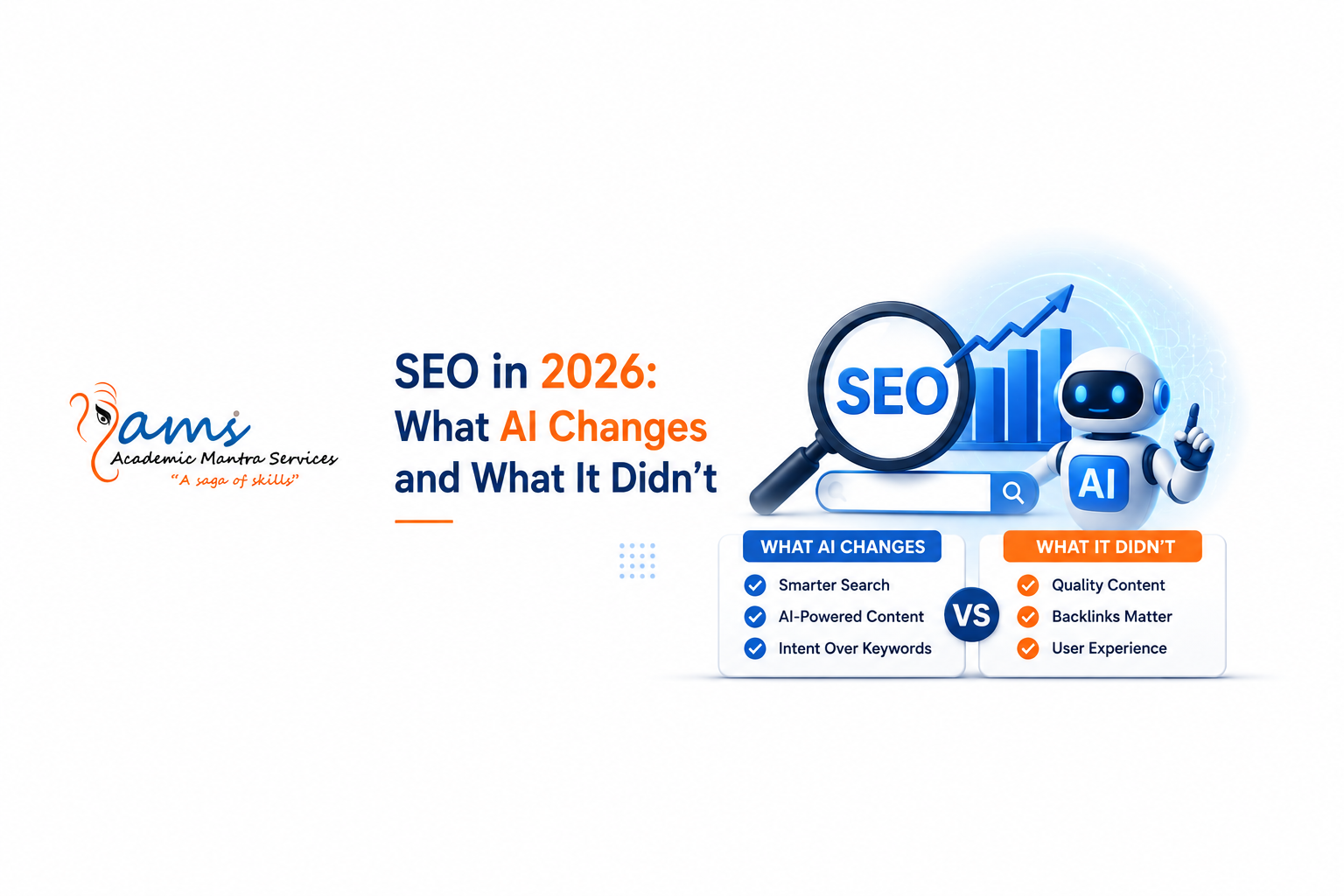
AI has changed SEO, but it hasn’t replaced it. In 2026, SEO is expanding beyond traditional Google ranking into AI Overviews, AI mode, conversational search, answer engines, and generative platforms. Businesses today need to optimize for traditional search visibility and AI discovery.
However, the fundamentals stay the same: understand search intent, create useful content, keep technical SEO, build authority, and make information easy for search systems to understand.
In a world where anyone can generate content with AI, the real advantage comes from creating something useful, original, and worth trusting.
SEO Didn’t Die. The Search Box Changed
“If AI can answer the question directly, why would anyone need SEO?” The question sounds simple, but the answer points to a much bigger shift in search.
Search is changing quickly. Google is expanding AI overviews and AI mode, while users shift more towards conversational AI for research, comparisons, and recommendations. In addition, AI-supported answers can change click behavior and make traditional rankings alone an incomplete picture of visibility.
AI did not make SEO irrelevant. It changed where and how SEO needs to work.
What AI Changed in SEO
From keywords to Search Intent
AI-supported search prompts people to ask longer and more specific questions. Search is transforming into something more detailed and conversational. Rather than depending on short keywords, users can now ask detailed questions, add follow-ups, and explore a topic through a single AI-supported conversation.
This means modern SEO should focus less on repeating exact keywords and more on understanding, like, what does the user want? What information do they need next? What problem are they trying to solve?
For example, instead of targeting only “ SEO training in Mohali”, a strong content strategy could also address questions such as: Is SEO still a good career? What is the difference between SEO, AEO, and GEO?
From ranking to AI visibility
Over many years, SEO teams mainly asked, “Where does this page tank?”
Now another question matters: “Is my content being discovered and surfaced in AI-supported search experiences?”
In June 2026, Google introduced new Search Console reports that show how frequently websites appear in AI Overviews and AI Mode, along with the pages, countries, devices, and data associated with those impressions.
This gives SEO experts a new way to understand where their content is appearing in AI-supported search– and how search visibility is evolving beyond traditional rankings.
From SEO Alone to SEO + AEO + GEO
The rise of AI-supported search has introduced terms such as Answer Engine Optimisation (AEO) and Generative Engine Optimisation (GEO).
- SEO focuses on visibility in search engines.
- AEO focuses on providing clear answers to user questions.
- GEO focuses on visibility within generative AI experiences.
What AI Didn't Change
1. Search Intent Still Comes First
Technology can change the interface, but the user still has a reason for searching.
Whether someone uses Google, ChatGPT, or another AI search platform, they are still looking for an answer, solution, product, service, or recommendation.
Understanding that intent remains one of the most important SEO skills.
2. Technical SEO Still Provides the Foundation
AI hasn't removed the need for a technically accessible website.
Important fundamentals still include:
- Crawling
- Indexing
- Internal linking
- Site architecture
- Mobile usability
- Page experience
- Structured data where appropriate
- Clear content organisation
A brilliant article is much less useful if search systems struggle to discover, understand, or access it.
3. Trust and Authority Still Matter
The web is becoming easier to fill with automatically generated information.
As a result, credibility becomes a stronger differentiator.
Businesses should show expertise through:
- Original insights
- Accurate information
- Reliable references
- Author expertise
- Real examples
- Transparent information
- Consistent brand presence
What This Means for SEO Professionals
This shift also changes what people should expect from SEO training in 2026. Learning only keywords, backlinks, and basic on-page optimization is no longer enough. Presently, learners need to understand how traditional SEO connects with AI-powered search, AEO, GEO, content strategy, analytics, and practical optimization. This is where choosing the right SEO training can make a meaningful difference.
Why Choose Academic Mantra for SEO Training?
Academic Mantra provides SEO Training in Mohali, especially designed around the shift from traditional SEO toward modern search. Its training covers on-page SEO, off-page SEO, technical SEO, Content optimization, keyword research, and AI-integrated SEO tools, also includes AEO, GEO, analytics, and live project implementation.
In addition, learners also get exposure to real website optimization projects and industry tools, as well as receive course-completion certification across its training pathways.