
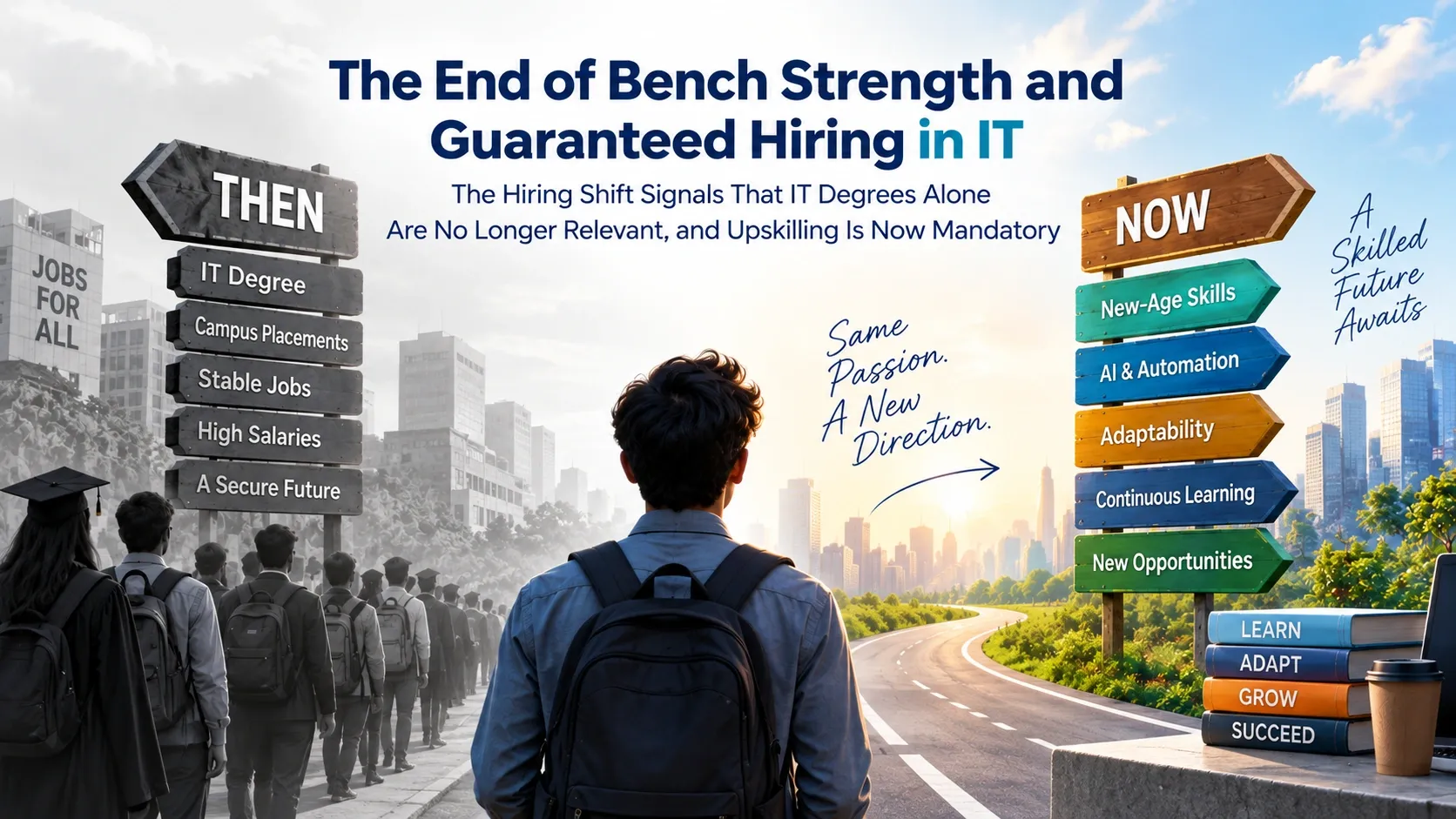
The end of the story of bench strength and guaranteed hiring in IT - The hiring shift signals that IT degrees alone are no longer relevant, and upskilling is now mandatory
Discussion covered for the reader of the article :
Fresher and entry-level despair:
The crisis worsens as ghost jobs and CV rejections driven by ATS algorithms persist, while parents, teachers, institutions, and communities continue to grapple with outdated mindsets.
Return to office vs Remote:
The pandemic temporarily boosted acceptance of remote work, seen as a benefit for employees. However, as companies emphasise performance with lean teams, Reddit discussions reveal a backlash against remote jobs compared to traditional office roles. While employee behaviours and health issues are debated–which will be merited in our next article - we share the responsibility for shifting remote roles back to office-based setups, especially as productivity, monitoring, and management become vital amid currency devaluation and inflation and performance. Once a responsibility is transferred, we bear the consequences and cannot blame the drop in productivity during the work-from-home period or companies corrective actions. The recent news about TCS being accused of monitoring employees laptops to maintain productivity highlights this issue.
Not enough IT jobs in the market:
The old system of creating IT batches does not generate enough jobs for entry-level and freshers. However, the new system is opening new opportunities. We should facilitate a smooth transition and be willing to adopt it, rather than rejecting it and risking obsolescence.
For years, many Indian parents have recommended that their children pursue computer science, secure an IT career, and earn lakhs. Growing up, numerous people believed IT roles were among the highest-paid in India and worldwide—and they truly were. Nearly every IIT graduate aspired to work at top tech firms like Google, Microsoft, and Apple.
How the IT boom transformed India?
Following the Y2K boom, millions of IT jobs emerged in America, but many labour-intensive roles -including basic developers, testers, support staff, coders, IT engineers, computer operaters, data entry executive, telecallers, and AMC services—were offshored to countries with lower labour costs such as India, China, Hong Kong, Singapore, Bangladesh, and Pakistan. India and China, in particular, became significant beneficiaries of this shift almost by default.
As the boom expanded, the demand for IT graduates increased significantly. Policy incentives led India’s engineering colleges to boost their output to over 70,000 graduates annually. In 2016-17, over 40 lakh students enrolled in BTech programs. The IT sector’s contribution rose from just 0.4% in 1991-92 to nearly 8% by 2017-18. IT export revenue also skyrocketed from $6 billion in 2000-01 to more than $315 billion by FY26. Ultimately, the IT sector became the primary engine driving the country’s economy.
The cost of overreliance on the IT industry:
However, amid that boom, students and institutes made a subtle yet expensive mistake: they depended too heavily on the sector, mistaking a growing industry for an endless one. History shows that when people rely too much on a single idea and refuse to question or change, they risk becoming obsolete – with no space for sunlight to shine through them.
Lessons From Companies That Failed to Adapt:
History offers many insights from leaders at influential companies who struggled to balance their personal beliefs with their overreliance on them as a ritual, which ultimately proved costly as they refused to make space for new ideas.
1. Intel and the Smartphone Opportunity:
First in line in our report is when Former Intel CEO- Paul Otellini (2005-13), who leaned heavily on the belief that they were perfectly protected in the PC market, decided against designing Apple’s first processor, doubting the margin and future possibility of the smartphone market. Apple now, as of date holds 20% market share of total global smartphones shipped worldwide, just behind Samsung ( as per report published on 28th Aug). In 2007, even former Microsoft CEO Steve Ballmer dismissed the idea that Apple could attain a significant market share based on its aggressive product pricing.
2. Ford and the Rise of the Automobile:
In 1903, when there were fewer cars than horses, limited paved roads, and even fewer gas stations in America, a Michigan bank president advised Henry Ford’s lawyer against investing in the newly founded Ford Motor Company. He said, ‘The horse is here to stay, but the Automobile is just a fad.’ Researchers attribute this decision to the prevailing conditions of the time, but it illustrates a key point: change only matters if you can recognise and adapt to it correctly in the given time frame and before everybody else does. Ford's current global market share is 5%, placing it 4th in the global automotive market. (Google)
3. Citibank and the Internet:
Jon Reed, the former Citibank CEO in 1984, misread the internet’s influence by limiting it to a playground for hackers and refused to accept it as a part of boosting business and commerce – blinding it to creating the commercial infrastructure required, causing a void costing the bank readiness. Global e-commerce trade as of 1st Sep 2026 -statistics show that 21% of worldwide business happens online.
4. Yahoo and the Rise of Google and Facebook:
Terry Semel, the CEO of Yahoo, failed to gauge the potential of Google or Facebook and failed to strike a deal priced at $5 billion and $ 1 billion between 2002 and 2006, respectively, stating they were inflated prices. Our firm, Academic Mantra, believes: Opportunity seldom knocks, and when it knocks, you should just open the door without much ado.
Infosys and the Early Warning Signs of AI:
A pertinent example related to the current topic is a case study of Infosys. Dr. Vishal Sikka, who became the non-founding CEO, very early in 2014, introduced Infosys to Elon Musk and Sam Altman when ChatGPT was being launched as a non-profit organisation. Infosys committed $1 billion initially to support this mission and promoted early reforms in the Indian IT sector.
The same aggressive push towards future AI and automation created a rift between the traditional management and Narayana Murthy. This disagreement eventually led to his ousting in 2017 and his subsequent launch of Hang Teng Systems in June 2026,located in California, focusing on automation rather than headcount-driven projects. The irony is that Sikka was already talking about warning signals and red flags in the IT industry. In an interview with CNBCTV18 in San Francisco, he commented, ‘So, whether a company survives or not is more a function of whether we transform ourselves in time to help everybody who needs help with these kinds of things, or will the wave come and destroy our prior way of working. I think these are very likely possibilities, and the wave is here, and it will wipe out the prior way of doing things.
He repeatedly urged the industry to move away from headcount-based billing and even engaged Panaya to help Infosys clients transition from headcount billing to automation and project-based models. Surprisingly, Infosys has created CRM systems for over 1,000 financial institutions in more than 100 countries (LinkedIn), using those insights- yet it struggled to find stability when its own sector was disrupted and it needed teh right financial insight to protect its investors and employees. Once Sikka left, the project was abandoned, and the AI roadmap was discontinued and shelved, termed a ‘governance issue’. Today, as ChatGPT has become a profit-driven organisation, Infosys has not capitalised on this shift and failed to move early, which could have been worth billions. The irony is that the entire IT industry, which resisted change is now facing the same crisis Sikka predicted. The sector is struggling with automation and trying to launch AI-first initiatives. Yet, despite being a booming industry, it has failed to stay ahead of the curve due to rigid beliefs and stereotypical institutional mindsets.
If leaders have faced challenges because they relied too heavily on certain strategies, it shows that ordinary people can make mistakes too. The crucial part is to learn from these failures and adapt for better outcomes. We all need to wake up to the message written on the wall: change is constant, and we must act now, collectively, as parents, students, and the institutional community.
Why an IT Degree Is No Longer Enough:
A computer science degree has become less about gaining skills and actual technical proficiency in the field and more of a launchpad for career growth on autopilot. Get the degree and someone, somewhere will hire you, for sure.
AI Didn’t Kill the IT Industry, It Changed It:
It’s surprising to see today’s narrative: many blame AI for ‘killing’ the IT sector, yet the sector isn’t dead. Instead, it has evolved; AI and automation have rendered some basic IT roles obsolete. Hiring in India for IT roles had already declined years before ChatGPT appeared. Fresher hiring by IT firms dropped from 26% of all engineering graduates in FY22 to 15% in FY23 and just 10% in FY24 - long before generative AI showed any significant business impact. India’s 4 leading IT outsourcing companies employed 243,000 workers two years before this decline, but only 82,000 the following year. This shift is mainly due to post-pandemic over-hiring correction and the rise of automation tools like RPA, which have been quietly replacing routine coding, testing, and support tasks since the mid-2010’s. Meanwhile, BTech enrolments had already fallen from about 40 lakh students in 2016-17 to 36 lakh by 2020-21, signalling a changing job market long before AI became a scapegoat.
From Degrees to Skills: The New Reality of IT Careers:
The traditional idea of getting a degree, finding a job, and settling down was never truly a strategy. With the rise of AI and automation, technology continues to be a top career choice for students. However, students' expectations have evolved. While an IT degree might get you into an interview, it doesn’t ensure a stable career, as the future of IT is constantly evolving with new-age AI and GEO interventions. Your skills and adaptability to handle incoming changes determine your professional growth. It is survival of the fittest - as we struggle to cope with AI power, ironically, we humans are the only ones powering it to its current level.
Read our following article on The New Age IT skills every IT fresher should know, which discusses the new-age IT skills required in the IT field for computer science students, IT students, cybersecurity professionals, network engineers, prompt engineers, loop engineers, IT engineers, data engineers, data scientists, and coders.