
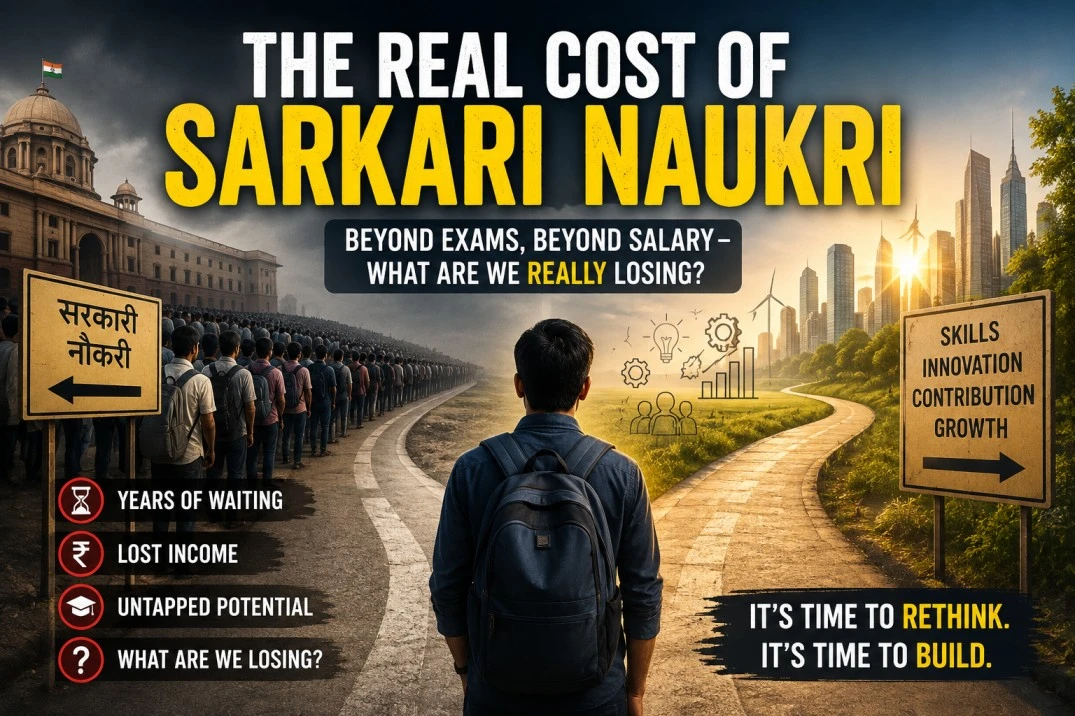
What is the real cost of Sarkari Naukri?
- Is Sarkari Naukri the only goal for Indians? Do we know the cost we are paying for it?
- Why do many talented individuals limit their journey to pursuing Govt. jobs and not contribute directly to India's growth?
- What are the real figures of the best Sarkari minds on innovations and contributions to Make in India beyond paperwork and oversight- after putting everything in qualifying the competitive exams?
- Is talent limited by exams?
- Should contributions and performance in a government job be considered for evaluation every 5 years, or should it simply be a job guarantee with a salary regardless of work done?
- Is selling Govt. institutions to private players for the government earning the only solution to better performance or it points clearly that performance is one thing that is lagging in Govt institutions?
- Did we pursue government jobs just to earn a salary paid by taxpayers, with little or no accountability?
The real cost of Sarkari Naukri is not just the examination fees, coaching fees, or even the years spent preparing for the exam. It is the opportunity cost of waiting.
Between 2014 and 2022, India received over twenty-two crore applications for seven lakh central government vacancies. Yet, more than 8.5 lakh sanctioned positions remain unfilled. The Railway Department, the largest employer in India’s organised sector and the eighth largest globally, has faced understaffing for nearly ten years. The core problem is not the lack of jobs but delays in hiring; the positions are available, but they remain vacant because of politics or a lack of zeal. Why vacancies remain despite millions of applications is a topic of debate and concern; we will revisit it in our coming blogs.
The article discusses more than just exams; it also emphasises what people sacrifice while waiting for them.
Meanwhile, the number of applicants keeps growing. Around 13-14 lakh students take the UPSC civil service prelims each year, only about 1% qualify for the mains, and roughly 0.1% make it to the interview stage. The final selection data for 2026 shows only 933 aspirants succeeded, which is a very slim chance of 1 in 1,400. Most aspirants do not succeed on their first try, yet the Sarkari Naukri trend persists regardless of real-world circumstances.
A recent youth-focused protest in Jharkhand concluded after 21 days on August 18, 2026. During the demonstration, students protested against irregularities in staff selection by the Jharkhand Public Service Commission. A surfaced video showed a 30-year-old student blaming the government for not securing a government job, despite his parents hailing from a humble background and struggling to pay coaching fees for these exams. Building on our earlier post, we noted that while jobs are available, 86% of Indians are deemed unemployable compared to the global standard of 82% owing to a skill gap. This figure has increased from 30-40% from early 2014 to recent years, based on industry data. Instead of focusing on why a student should wait for a government job, industry now demands that youth develop skills that secure them any job. However Indian society has fostered a strong love for government jobs for a long time, and we must take responsibility for this. We have prioritised government employment as the ultimate life goal because it guarantees a stable income even without working. In the past, India was struggling to develop, with industrial growth mainly driven by giants like Maruti, TATA, and Birla. Industrialisation aspirations were seen within that limited framework. However, times have changed, along with our expectations and work habits. Still, government jobs maintain a strong hold in remote parts of India, where a girl might marry or divorce just because someone has a government position. Did we pursue government jobs just to earn a salary paid by taxpayers, with little or no accountability?
Government jobs still attract long queues of applicants, and training institutes continue to train millions and earn. Although only a few make it through, the love for these careers keeps growing.
We do not oppose the UPSC exam being challenging, given the significance and responsibility of the role and a high difficulty level is justified. We agree with that. However, the difficulty of an exam and its relevance are separate issues. While an IAS officer’s work is action-oriented, they are selected through nine descriptive exams that focus more on memorisation than on practical governance skills.
Choosing 180 cadres or ‘Sarkari babu’s’ as they are preferably called - each year involves a complex screening process. It includes detailed face-to-face interviews assessing practical skills, but it raises questions.
What are the real figures on their innovations and contributions to Make in India beyond paperwork and oversight?
Remarkably, only about 5% of the top candidates demonstrate innovative thinking and pursue new initiatives to solve problems or contribute to India's progress.
While 15% of the data indicates that early adopters and intelligent individuals do not partake in innovations, they are nonetheless quick to adopt changes and new frameworks.
About 80% of our talented individuals operate strictly within established rules. Their main focus is on core administrative tasks, such as maintaining law and order, updating land records, distributing routine budgets, and following protocol.
The discussion on Quora, reveals that most conversations focus on viewing the role as a job rather than emphasising transformation or change. While we acknowledge that officers often respond to political influences in their service, true innovation should not be tied to any political party.
We do not doubt their talent, hard work, or contributions to society. Clearing an IAS exam requires true grit and perseverance, and since we haven't taken the same path ourselves, we don't want to diminish their efforts with our remarks. That is precisely the point - we work so hard to get selected, but then why are we not contributing to the India story. This is just an observation, and others may disagree. Interestingly, based on available data, which is either scarce or not fully shared in the public domain, the findings are disappointing.
The solution might involve adjusting the current application criteria and the associated limits for each category. We need the best minds working for our country's benefit, especially if we are sponsoring their salaries, rather than just catering to the political community. Currently, the general category has an age limit of 21 to 32 years, while OBC and SC/ST categories are extended to 35-37 years. Additionally, the number of attempts is limited to 6 for the general category, whereas OBC candidates can attempt up to 9 times and SC/ST candidates have an unlimited number of attempts. Was it not supposed to be vice versa when you have already limited entry for the general community. By saying this we are not advocating a debate of the caste system - it is just our point of reference.
Does this imply that only 180 selected individuals for IAS are suitable to govern, while others are excluded? Although reattempts are permitted, the system seems to restrict a broader influx of talented people into the mainstream based on outdated criteria. - like the exams. This approach needs urgent revision—allow the best candidates to participate equally, without relying on assumptions and quotas. Furthermore, exams shouldn't be the sole method for choosing candidates, and government jobs shouldn't be regarded as the ultimate goal.
Why do many talented individuals limit their journey in pursuing Govt. jobs and not contribute directly to India's growth?
We need a system that allows individuals to use their talents fully and participate actively in development, rather than just supporting existing systems. The IAS selection process highlights the rigorous testing involved, but other tough exams like GATE, IIT JEE, CA, NDA, and NEET are equally challenging. For example, in NEET-UG 2026, 11,21,185 candidates qualified out of 20 lakh who appeared and that is about 50% selection numbers. But does that mean the other 50% lack intelligence or are not capable of becoming a doctor?- Are we even listening to the loud cries that need immediate attention?
Are capable individuals - being excluded and a dream wiped out- based on their caste, outdated exam pattern- and scams? Some of them, if given a choice of a different mode of selection could have been excellent regional doctors and added to the poor doctor to patient ratio in the rural areas which is 1:11000 compared to the national average of 1:800 ( though the ratio includes ayurvedic and allopathic doctors both) against WHO requirement of 1:1000 at least . Considering the low doctor-to-citizen ratio in India and that village people still travel an average of 14 km for regular and 43km for basic quality treatment after 80 years of independence, why is access and enrollment to become a doctor still limited by an exam- when the scarcity is killing our citizens?
On the other side we have the NEET paper leak and somewhere these seats are being sold through other illegitimate means, such as cash payments for seats or auctioning to the highest bidder.
Instead, selection should be based on performance in practice and health and who are willing to take the tougher route of serving the nation by making themselves available for treatment at the remotest of the places at least for some years. The long-standing model may aim for equality,and quality - but the shortage of doctors and institutions persists. So, what core problem are we trying to address?
Even the government’s own reform body agrees with this. The 2008 Second Administrative Reforms Commission stated that it is hard to determine if successful candidates are temperamentally suited for their assigned services. Additionally, tougher exams often mean losing prime years of one’s life to a job they may never attain. RBI Governor D. Subbarao reflected that the years spent preparing for the UPSC were an “abysmal waste” of his productive life. The key issue isn't whether the exam standards are high enough, but whether they are appropriate. Furthermore, examination statistics rarely include a less obvious cost: the financial burden.
What is the cost we pay in becoming Govt Servants or Sarkari Babu’s ?
An aspiring candidate doesn't only pay exam fees. Years of preparation involve costs like coaching, books, test series, accommodation, food, travel, and repeated attempts. Students moving to coaching hubs face full-time financial commitments, often supported by parents or loans.
However, these costs represent income they forgo. A 22-year-old joining the workforce might earn 15000-20000 rupees initially, totalling around 6-7 lakh rupees over three years without considering raises. Meanwhile, a full-time aspirant spends those same three years earning nothing. This opportunity cost is non-refundable, unlike exam fees.
A similar trend is observed in the railway and SSC exams. When RRB announced 32,438 Group D positions, 15.6 lakh candidates applied, averaging about 48 applicants per vacancy for a role offering an entry-level salary of 18,000 INR per month - a surprise, since higher skill based jobs offering double the salary are available but people think of these jobs as they offer salary even with or limited work.
SSC CGL announced 14,582 vacancies, with lakhs of students applying. When you consider similar numbers for UPSC, SSC, railway, banking, and over two dozen state PSCs, it reveals a nationwide trend: an entire generation, aged 21 to 30 and in their most productive years, is concentrated in coaching hubs like Kota, Prayagraj, Delhi’s old Rajinder Nagar. They spend their time memorizing GK questions and taking mock exams, knowing that 97% will be rejected. The impact isn’t just the years spent studying; it's also the missed opportunity to develop meaningful experience and skills.
The job market values experience and skills, leading to a paradox: the longer someone waits for a government job, the harder it is to envision an alternative career, and the more they have invested in preparation, the more difficult it becomes psychologically to abandon their efforts. Years of frustration can overflow into collective protests, such as the CJP demonstrations, where students and job seekers unite to protest exam irregularities, paper leaks, and a recruitment system they perceive as unreliable and unjust.
However, the undeniable issue everyone avoids discussing is whether this system is meant to select talent or simply to postpone unemployment management.
Do we know the cost we are paying for it?
The first 5-10 years is what drives your career- Be wise before you burn your youth.
When we evaluate the three-stage UPSC process, It shows how it can take several years, and with re-attempts, it might cost prime years where a candidate could have optimised their energy and youth for better performance in a different career or pursuing various skill programs with Academic Mantra services. During this period, individuals lack regular salary, experience, or pension, and they do not acquire any skills that could be useful in new fields. India doesn't necessarily lose candidates who fail the exam; instead, it risks losing years of potential productivity from those who could contribute to businesses, startups, schools, hospitals, technology, and other sectors of the economy. We pride ourselves on being the youngest country, but are we truly focusing on how to develop the next generation to lead our country? The statistics on how they consume online content, videos, and social media are already concerning when compared to global standards.
What needs to change? Stay tuned for our next blog— the solution isn't "make it easier," but "make it faster."